Application of Physics-Informed Neural Networks for Spring Slider
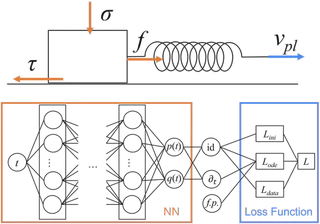
Developed the PINN-based method to simulate fault slip with rate and state friction law and estimate the frictional parameters in a spring-slider system.
Abstract
Slow slip events (SSEs), which are fault slips characterized by slower velocity and longer duration compared to earthquakes, have been observed in many subduction zones. Monitoring SSEs is important for understanding large earthquakes because they occur adjacent to areas where significant earthquakes could potentially occur.
Different types of fault slips, including SSEs and earthquakes, can be explained by distinct frictional properties on the fault. These frictional properties can be estimated from physical laws of fault slip and observed crustal deformation.
In this study, we propose a new machine-learning based approach for fault slip monitoring. We employed Physics-Informed Neural Networks (PINNs), which simultaneously learn the physical laws and data, to simulate fault slip, estimate the frictional parameters, and predict subsequent fault slip.
As a first step, we utilized a single-degree-of-freedom spring-slider system, which is the simplest physical model to simulate SSEs. We successfully simulated SSEs, estimated frictional properties from synthetic observation data, and discussed the potential for fault slip prediction. Our results suggest the significant potential of PINNs for fault slip monitoring.
Paper
Fukushima, R., Kano, M., & Hirahara, K. (2023). Physics-informed neural networks for fault slip monitoring: Simulation, frictional parameter estimation, and prediction on slow slip events in a spring-slider system. Journal of Geophysical Research: Solid Earth, 128, e2023JB027384.
